
Blog · Laser resurfacing
UltraClear laser: what it costs, what it treats, and what recovery is like
Medically reviewed by Michael Brown, PALast reviewed
If you have been looking into laser resurfacing, you have probably met two questions at once: what does the UltraClear laser actually cost, and what are you signing up for in recovery? This guide answers both, with the numbers the manufacturer, the FDA and published studies give, and with what a treatment costs at Afterglow in Corte Madera.
What the UltraClear laser is
UltraClear is a resurfacing laser made by Acclaro Medical. It is a 2910 nm erbium-doped fluoride glass fiber laser. That wavelength sits at the peak of water absorption, so the energy is taken up by the water in skin cells and removes tissue in very fine columns with little heat spreading into the skin around them. Acclaro calls this “cold” ablation, and markets the device as the first cold fiber laser of its kind.
The practical point is the settings range. One device runs from a light surface treatment that the manufacturer positions as a lunchtime visit, through deeper fractional treatment that reaches the dermis, to full ablation and a tissue-coring mode for deep folds. The same laser can be dialled to the concern in front of it and to the recovery time you can afford.
The FDA has cleared the UltraClear Fractional Laser System under 510(k) K233803, and Acclaro lists its cleared uses as fine lines, wrinkles, age spots, scar revision, acne scars, actinic cheilitis, skin resurfacing, benign pigmented lesions and vascular dyschromia.
What it treats
The concerns that bring people to UltraClear are the ones the clearances describe:
- Fine lines and wrinkles, including the lines around the nose and mouth.
- Texture: skin that feels rough or looks less smooth, enlarged pores, crepey skin along the lower face.
- Sun damage and uneven tone, including age spots and other benign pigmented lesions.
- Scars, including acne scars. A 2024 case series in Lasers in Surgery and Medicine reported improvement in scars of several kinds after a single treatment in patients with Fitzpatrick skin types I to IV.
- Deep folds and jowls, with the Laser-Coring mode, which removes tiny cores of tissue along the jawline and neck to tighten skin.
Resurfacing improves skin quality. It is not surgery. Significant sagging or lost volume may need a different approach, and your provider will say so at the consultation rather than sell you a laser for a problem it cannot fix.
How much does UltraClear laser cost?
Prices vary with how deep the treatment goes, how much of the face is covered and how many sessions you need. For a sense of the range, a university dermatology department’s published 2026 fee schedule lists UltraClear at $1,000 per treatment for a light “laser peel” of the face, $1,500 for the face and neck, and $1,500 to $5,000 per treatment for deep resurfacing, depending on whether it covers part of the face, the full face, or the face and neck.
At Afterglow in Corte Madera, UltraClear is priced by how deep the treatment goes:
| Treatment | Price | What it targets |
|---|---|---|
| Refresh: light | $1,500 | Dullness, rough texture, superficial sun damage and fine lines |
| Restore: moderate | $3,500 | More noticeable wrinkles, uneven pigmentation and acne scars |
| Deep: intensive | $5,000 | Deeper wrinkles, pronounced texture changes and acne scarring |
| Laser-Coring | $9,000 | Skin laxity, deeper wrinkles and scars, including concerns around the lower face and jawline |
| Requesting a consultation is free. Once a time is confirmed, a $25 deposit holds it, and if you begin treatment with Afterglow the deposit is applied to your care. |
Downtime and recovery
How long you need depends on the setting, and the honest answer is that the same device produces very different recoveries.
Physicians describing the lightest settings in the trade press report treatments with no topical numbing, “minimal downtime” and “low social downtime”: a short visit with some pinkness afterwards. The manufacturer describes the deeper fractional and full-ablation modes as needing more recovery, without putting a number of days on it. For comparison, Acclaro says that CO2 lasers often involve “up to 21 days” of downtime, and that UltraClear’s lower heat delivery is what shortens recovery relative to that.
Whatever the depth, the skin heals the way resurfaced skin heals. Redness, swelling and some crusting or peeling are normal. Changes in pigment, infection and scarring are possible with any ablative laser, which is why your skin tone, your history of pigment change and scarring, past procedures, medications and how you heal are all reviewed before treatment.
What to plan for at Afterglow:
| Treatment | Expected recovery |
|---|---|
| Refresh | Minimal downtime; temporary redness and sensitivity |
| Restore | About 3 to 5 days |
| Deep | About 5 to 10 days |
| Laser-Coring | About 5 to 10 days |
Aftercare: gentle cleansing, the healing ointment your provider directs, no picking or exfoliating, and strict sun protection. Makeup and active skincare resume when your provider clears you.
UltraClear vs CO2
CO2 lasers work at 10,600 nm. They also ablate with water-absorbed energy, but a large share of that energy becomes heat in the surrounding tissue. The heat is part of how CO2 tightens skin, and it is also what lengthens recovery and raises the risk of pigment change in darker skin.
Acclaro’s claim for UltraClear is that 95 percent of the energy goes into ablation and about 5 percent into heat, which it links to shorter recovery and to treating skin of colour that CO2 lasers cannot safely treat. That claim comes from the manufacturer. The physicians interviewed in the trade press make the narrower point that they can treat all skin types with the device and that patients recover faster than with the heavier lasers they used before.
Neither device is simply “better”. Deep wrinkles and advanced sun damage are still sometimes a CO2 case. The questions to settle with your provider are how much improvement you want, how much recovery you can take, and what your skin tone and history allow.
How many sessions
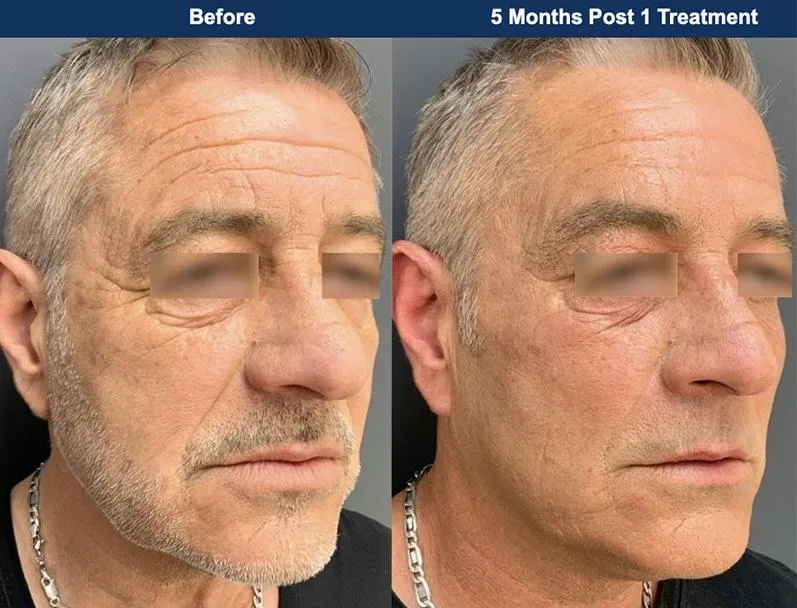
The manufacturer’s published before-and-after cases show tone, texture and wrinkle results labelled as one treatment and acne scars labelled as two, and the Lasers in Surgery and Medicine case series reported scar improvement after a single session. For the lighter anti-ageing programme, the physician interviewed by Modern Aesthetics described a series of short treatments every two months.
At Afterglow:
| Treatment | Typical number of sessions |
|---|---|
| Refresh | 1 to 3 sessions, depending on your goals |
| Restore | 1 to 3 sessions, depending on the wrinkles, pigmentation or scarring |
| Deep | One treatment to start, then a reassessment after healing |
| Laser-Coring | One treatment to start, then a reassessment as results develop |
Does it hurt?
Physicians using the device report that a wide range of superficial and collagen-remodelling treatments are done without topical numbing, and that Laser-Coring is done with topical anaesthetic and, optionally, nitrous oxide. At Afterglow, topical numbing is used, and Pro-Nox nitrous oxide is available if you want it.
Who it suits, and who should wait
UltraClear suits someone whose concern is skin quality: lines, texture, tone, sun damage or scarring. It is designed to be used across skin types, including darker skin, with the settings chosen for the individual.
Before treating, your provider reviews your skin tone, any history of pigment change or scarring, past procedures, your medications and how you heal. Active skin infection, a tendency to keloid, recent isotretinoin and pregnancy are the kinds of things that change the plan, and the consultation is where they are weighed.
UltraClear at Afterglow
UltraClear treatments at Afterglow are performed by Cathy Guthrie, Nurse Practitioner, at the Corte Madera clinic at 520 Tamalpais Drive, Suite 204, serving Marin County and the Bay Area. It is not currently offered at Los Gatos. The consultation is where the area, the setting, the preparation and the recovery are agreed before anything is booked.
QUESTIONS
Frequently asked questions
How much does an UltraClear laser treatment cost?
At Afterglow in Corte Madera, a light Refresh treatment is $1,500, Restore is $3,500, a Deep treatment is $5,000 and Laser-Coring is $9,000. Published fee schedules elsewhere run from about $1,000 for a light face treatment to $5,000 for deep resurfacing of the face and neck.
Is UltraClear better than a CO2 laser?
They are different tools. UltraClear's 2910 nm wavelength is absorbed by water with far less heat spread into surrounding skin, which the manufacturer links to shorter recovery and to safe treatment of darker skin types. CO2 lasers heat more tissue and typically need a longer recovery. Deep wrinkles and heavy sun damage are still sometimes a CO2 case; your provider will say which suits you.
How long does UltraClear take to heal?
It depends on the depth. At Afterglow, a light Refresh treatment has minimal downtime, with temporary redness and sensitivity. Restore takes about 3 to 5 days, and Deep and Laser-Coring treatments about 5 to 10 days. Redness, swelling and peeling are normal as the skin heals, and you leave with aftercare instructions.
Does the UltraClear laser hurt?
Afterglow uses topical numbing for UltraClear, and Pro-Nox nitrous oxide is available if you want it. Physicians using the device report that many lighter treatments need no numbing at all.
Is one UltraClear treatment enough?
Sometimes. At Afterglow, Refresh and Restore typically take one to three sessions, depending on your goals. Deep and Laser-Coring start with one treatment, and the result is reassessed after healing. A published case series also reported scar improvement after a single session.
Is UltraClear safe for darker skin?
The manufacturer and physicians publishing on the device describe it as designed to treat all skin types, including skin of colour, because the 2910 nm wavelength ablates with very little bulk heating. Your skin tone and your history of pigment change or scarring are reviewed before any treatment.
Related treatments
Sources
- Acclaro Medical, UltraClear laser: modules, concerns treated and before-and-after cases
- Acclaro Medical, "CO2 vs Cold Fiber Laser", 29 June 2026: cleared indications and the CO2 comparison
- U.S. FDA, 510(k) K233803, UltraClear Fractional Laser System (Acclaro Corporation), 2024
- Modern Aesthetics, "UltraClear from Acclaro", Sep–Oct 2022 (interview with Lesley Clark-Loeser, MD)
- Dermatology Times, "Paul Friedman, MD: An In-Depth Review of UltraClear Laser-Coring", 4 January 2024
- Murray T, Guo A, Richmond S, Friedman PM. Single treatment scar resurfacing with a novel ablative fractional 2910 nm erbium-doped fluoride glass fiber laser. Lasers Surg Med. 2024;56(1):19–22
- Oregon Health & Science University, Cosmetic Dermatology fee quote sheet, updated January 2026 (UltraClear per-treatment fees)
